Crawl, Walk, Run: An Incremental Path Into AIDLC
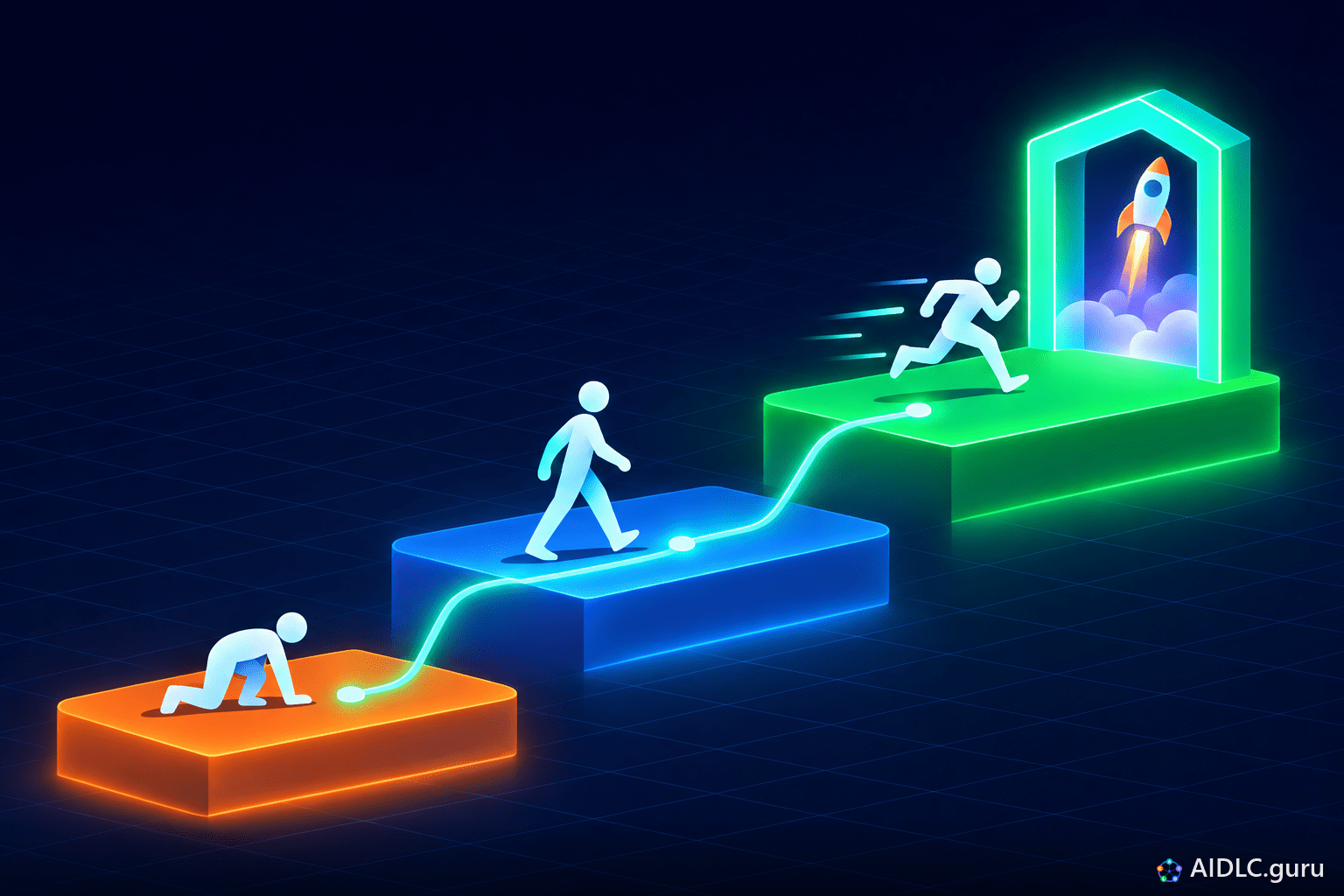
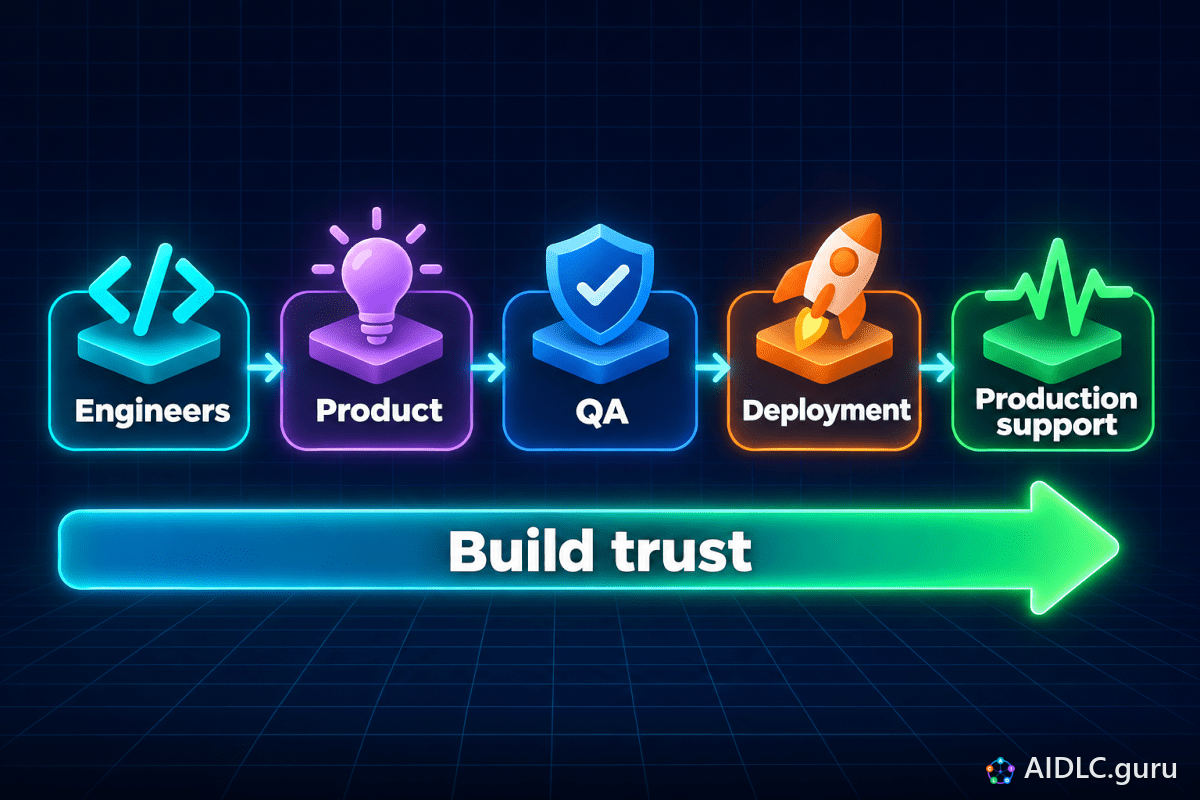
"My team is stuck in the old way of doing things. How do we break into AIDLC?" It is the question engineering leaders ask most. The answer is not a reorganization or a big-bang rollout. It is a sequence: start with the engineers who write code, expand to product, then to QA, then to deployment, and build trust at every step before taking the next one. This page lays out that order and the reasoning behind it, drawn from how RJ Lindelof introduced it to his own engineering group.
The Question Every Engineering Leader Asks
Most teams that want AIDLC are not starting from nothing. They have a working delivery process, people who are good at it, and years of habit behind it. That is exactly what makes the first move hard: the old way still ships software, so nobody is forced to change.
A framework diagram does not help here. The five phases describe where a team ends up, not where it starts on Monday. What a leader needs is an order of operations: which group goes first, what "done" looks like for that group, and what has to be true before the next group joins. Crawl, walk, run is that order. Each stage is small enough to try without betting the quarter on it, and each one produces the evidence that makes the next stage an easy decision.
Already past the first experiments? The First 30 Days plan covers one team's first month in detail, and the Rollout Playbook covers scaling across an organization. This page comes before both: it is about the sequence.
The Path at a Glance
Five steps, taken in this order. Each one starts only after the step before it has earned the team's trust.
The people who write code start first. Coding agents go into daily work, inside the review process the team already has.
Product uses AI to research, define the details and explain the problem being solved in every story.
Automated tests are generated from the acceptance criteria. Manual regression testing ends.
Releases move from a button press, to an automatic build that waits for one click, to deploying on push.
Extra credit: an AI agent becomes the first line of production support, with people behind it.
Before Step One: Find the Big Wins
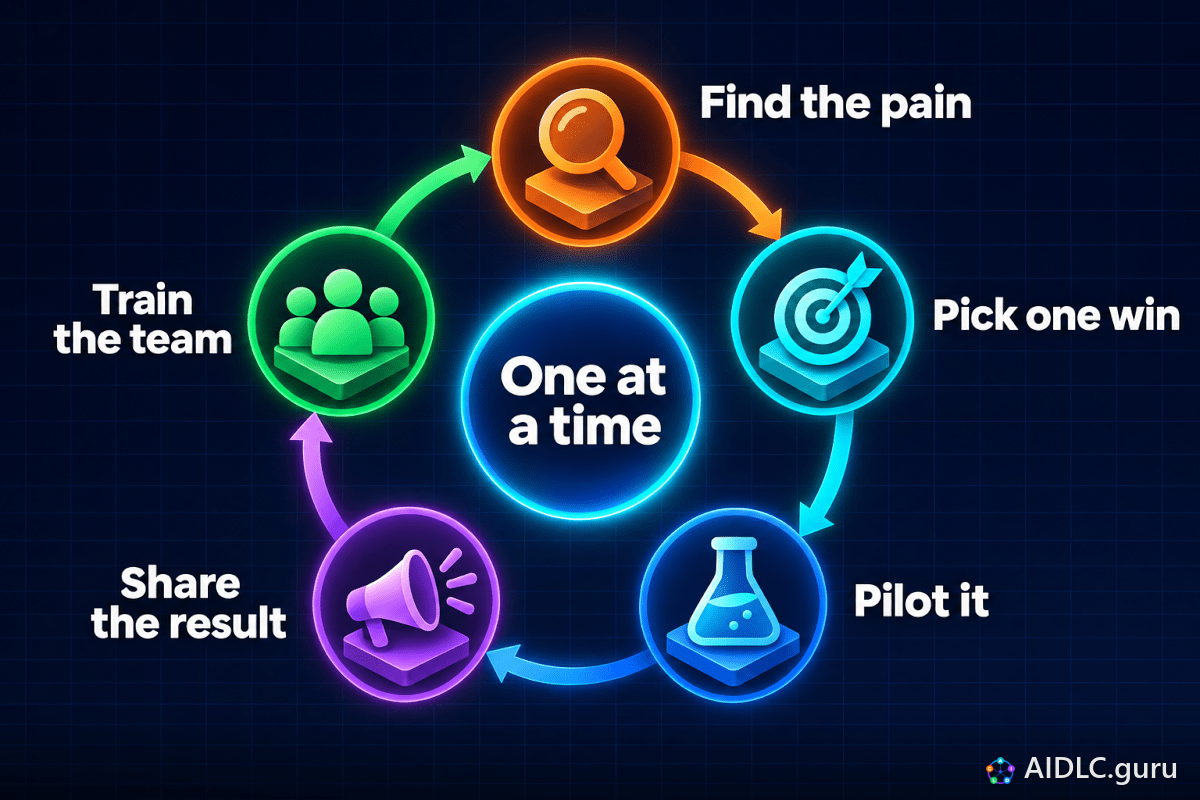
Do not start with a tool. Start by analyzing the engineering group the way you would analyze a product problem. Look for the work that is repetitive, the work that is time-consuming, and the work everyone avoids. Those are the places where a change is easy to see and easy to defend.
Then take the wins one at a time. A team that changes five things at once cannot tell which one helped, and cannot recover cleanly when one of them goes wrong.
Find the pain
Ask each team what they repeat every sprint and what takes far longer than it should. Boilerplate, test data, release notes, regression runs and ticket grooming come up again and again.
Pick one win
Choose the one with the largest visible payoff and the smallest blast radius. Write down how it works today so there is a before to compare against.
Pilot it
Run it with a few willing people on real work. Keep the old way available until the new one has proved itself.
Share the result
Show the before and after to the whole group, including what went wrong. A demo from a peer persuades more people than a mandate from a manager.
Train the team
Turn the pilot into a written process and teach it. A new way of working that lives in three people's heads is not adopted yet.
One at a time
Go back to the list and take the next one. The loop is the adoption plan; the five steps below are simply the order the wins tend to arrive in.
Step 1: Start With the Engineers Who Code
Engineers go first for three reasons. Their work is already checked by something objective: a build, a test suite and a code review. The feedback is fast, so they learn within hours whether an agent helped. And a mistake is cheap to undo, because nothing reaches production without passing the gates that were already there.
This is the Develop phase adopted on its own. Nothing else in the organization has to change yet.
What changes
- Engineers use a coding agent on real tickets, not side projects
- The repository gets a rules file that tells the agent how this codebase works
- Tests are written from the acceptance criteria before the code
What stays the same
- A person reviews and merges every change
- The same build, tests and review rules apply to agent-written code
- The engineer who opens the pull request owns what is in it
Ready for the next step when
- Most engineers use the agent without being asked to
- Review has kept up with the larger volume of changes
- Engineers start complaining that tickets are too vague for the agent
That last signal matters. Once code is quick to write, the slow part becomes knowing what to build. Engineers feel it first, and their complaint is the invitation to bring product in. Tool choice is covered in Choosing a Coding Agent, and the review load in AI Code Review at Scale.
Step 2: Bring In Product
An agent builds exactly what the story says and guesses at everything the story leaves out. So the second step moves upstream: the product team uses AI to research, to define the details, and to explain the problem being solved in the story itself.
This is the Analyze phase, and the start of Ideate. The engineers from step one are the customers for it, which is why it lands well: they asked for it.
Research
An agent reads the support tickets, interview notes and usage data and drafts what customers are actually asking for. A product owner checks every claim against its source.
Define the details
Edge cases, constraints and acceptance criteria are written down before the work is assigned, not discovered in review. The agent is good at asking "what happens when".
Explain the problem
Every story says who has the problem, what they need and why it matters. A story that only names a feature leaves the agent to invent the reason.
Ready for the next step when stories arrive with acceptance criteria an engineer can turn straight into tests, and when work stops bouncing back to product with questions. The skill itself is covered in Problem Definition and ACDD.
Step 3: QA and the End of Manual Regression
With clear criteria coming in from product, automated test generation becomes possible. An agent writes the unit, integration and contract tests from the acceptance criteria, in Develop, before the code that has to pass them. The suite grows with every story instead of being a project of its own.
The goal is plain: no more manual regression testing. Nobody clicks through the same screens before every release. That does not remove QA. It changes the job from running checks by hand to deciding what must be checked and proving that it is.
| QA work | The old way | After this step |
|---|---|---|
| Regression | A manual pass through a script before each release | The automated suite runs on every change and again on the integrated release |
| Test authoring | Written after the feature, when time allows | Generated from the criteria before the code, then reviewed by a person |
| Where QA spends time | Executing checks | Sharpening criteria, reviewing generated tests, exploratory testing and release assurance |
| A gap is found | Logged as a bug, retested by hand next time | It becomes a failing test that goes back to Develop and stays in the suite |
Ready for the next step when a release candidate that passes the suite is one the team would actually ship, without a manual pass "just to be sure". Until that is true, automating deployment only ships problems faster. Who writes which test, and when, is laid out in Testing Strategy.
Step 4: Deployment in Three Stages
Deployment is where crawl, walk, run is most literal. The right mechanism depends on the company: a commit, a push, a button, a pipeline. What matters is that each stage removes one manual step and that the team moves on only when the current stage has stopped surprising anyone.
Button-press deploy
A person decides to release and presses one button. Everything after the button is automated and repeatable.
Trust earned: the deploy works the same way every time, and a rollback has been rehearsed.
Auto-build, one click
Every merge builds itself, runs the full suite and stops almost all the way to production. A person looks at a finished release candidate and clicks once.
Trust earned: the click has become a formality. Nobody can remember the last time they declined to press it.
Deploy on push
A reviewed, merged change goes to production with no further human step. The gates decide, and they stop the release when a check fails.
Trust kept: health checks and automatic rollback catch what the suite missed.
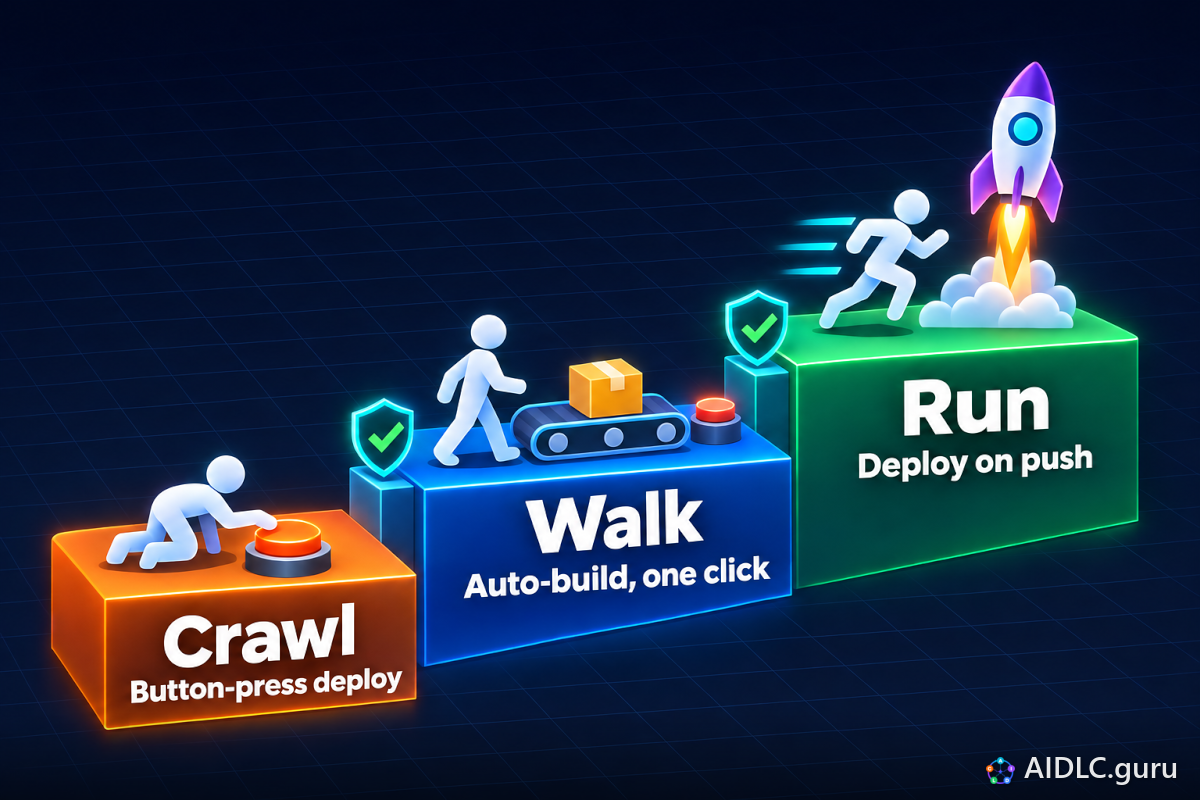
Even at the run stage a person still approved the change: a human owns every merge. What goes away is the second, ceremonial approval between a verified build and production. Some teams stay at walk on purpose, because a regulator or a customer contract requires a named approver for each release. That is a valid end state. See Launch and Regulated Industries.
Trust Is the Gate Between Stages
The key to the whole path is to build trust and then move, never the other way around. Trust here is not a feeling. It is a record: the new way has run long enough, on real work, that people have stopped double-checking it.
Signs you can move on
- The safety net at this stage has caught a real problem at least once
- People no longer keep the old process running "just in case"
- The skeptics on the team would be annoyed to go back
- The process is written down and a new hire could follow it
Signs you moved too soon
- People quietly redo the automated step by hand
- A failure leads to blame for the tool instead of a new check
- Only the people who built the new process know how it works
- The next stage was scheduled by date, not by evidence
Moving too soon is recoverable: step back one stage, add the missing check, and try again. What is hard to recover is a team's willingness to try after a change was forced on it and failed in public.
Extra Credit: AI as the First Line of Production Support
Once code, stories, tests and deployments all flow through agents and gates, production support is the natural next place to look. An agent can be the first responder: it reads the alert, pulls the logs and recent changes, matches the symptom against the runbook, and either resolves a known issue or hands a person a diagnosis instead of a raw page.
This is the Curate phase closing the loop. It comes last because it depends on everything before it: a first responder is only as good as the runbooks, tests and deployment history it can read.
The agent triages and summarizes. Every action is taken by a person.
The agent proposes a fix from the runbook and a person approves it with one click.
The agent carries out a short, written list of safe actions on its own and escalates everything else.
The same rule applies as everywhere else on this path: an agent may act only inside limits a person has set, and every action it takes is logged. See Agents in the Pipeline and Agent Observability.
How the Path Maps to the Five Phases
AIDLC runs Analyze, Ideate, Develop, Launch, Curate. Adoption does not follow that order. It starts in the middle, where the feedback is fastest, and grows outward in both directions.
| Adoption step | Who | AIDLC phase | What it unlocks |
|---|---|---|---|
| 1. Engineers | Developers | Develop | Faster authoring, and the demand for clearer stories |
| 2. Product | Product owners, designers | Analyze and Ideate | Criteria precise enough to generate tests from |
| 3. QA | QA engineers | Develop (tests first) and Launch (assurance) | A suite the team trusts enough to release on |
| 4. Deployment | Platform and operations | Launch | Small, frequent, boring releases |
| 5. Production support | On-call engineers | Curate | Lessons from production flowing back into Analyze |
Common Mistakes
Starting with deployment
Automatic deploys on top of manual regression and vague stories ship defects faster. Deployment is step four for a reason.
Changing everything at once
When five things change together, nobody can say which one helped, and one failure discredits all five.
Buying licenses and waiting
Access to a tool is not adoption. Without a chosen win, a pilot and training, usage stays with the few people who were already curious.
Skipping the trust stage
Going from a button press straight to deploy on push, because the pipeline can technically do it, removes the period in which the team learns to believe the pipeline.
Leaving product out
Engineers with agents and stories without detail produce a lot of confident code that solves the wrong problem.
Treating QA as the cost to cut
Ending manual regression frees QA for harder work. Teams that remove the people along with the task lose the judgment that decides what to test.
More of these, with the research behind them, are in Failure Patterns.
Frequently Asked Questions
Start with the engineers who write code. Their work is already checked by builds, tests and code review, so feedback is fast and a mistake is cheap to undo. Then expand to product, then QA, then deployment, and treat AI as the first line of production support as extra credit once the rest is working.
Crawl is a button-press deploy: a person decides to release and everything after the button is automated. Walk is an automatic build that runs the full suite and stops almost all the way to production, waiting for one click. Run is deploying on push, where a reviewed and merged change reaches production with no further human step.
When the current stage has earned trust: its safety net has caught a real problem, people have stopped keeping the old process running just in case, and the new process is written down well enough for a new hire to follow. Move on evidence, never on a date.
No. It ends the task, not the role. QA engineers move from running checks by hand to sharpening acceptance criteria, reviewing the tests an agent generates, exploratory testing and release assurance. That judgment is what decides whether an automated suite can be trusted.
Pick One Win and Start
You do not need the whole path planned. You need one repetitive task, a few willing engineers and a before to compare against.
Socialize, Promote and Train
A new process that works is only half of adoption. The other half is making sure everyone knows it exists, believes it works, and can do it themselves. Leaders tend to underinvest here, and it is the cheapest part.
Socialize
Talk about the change before it arrives. Ask the people affected what worries them, and let those answers shape the pilot. Nobody should learn about a new process from the announcement.
Promote
Show each win in front of the whole group, and give the credit to the people who did it. Include what failed. An honest demo builds more trust than a polished one.
Train
Teach the new process on real work, in pairs, and write it down. Budget the time for it. Training squeezed into spare moments tells the team the change is optional.
How roles and skills shift as this happens is covered in Teams and Skills.