AIDLC vs AWS AI-DLC
Same acronym, different frameworks. Two approaches share a name because the industry converged on the same problem - the SDLC needed rebuilding around AI. This page maps the differences honestly.
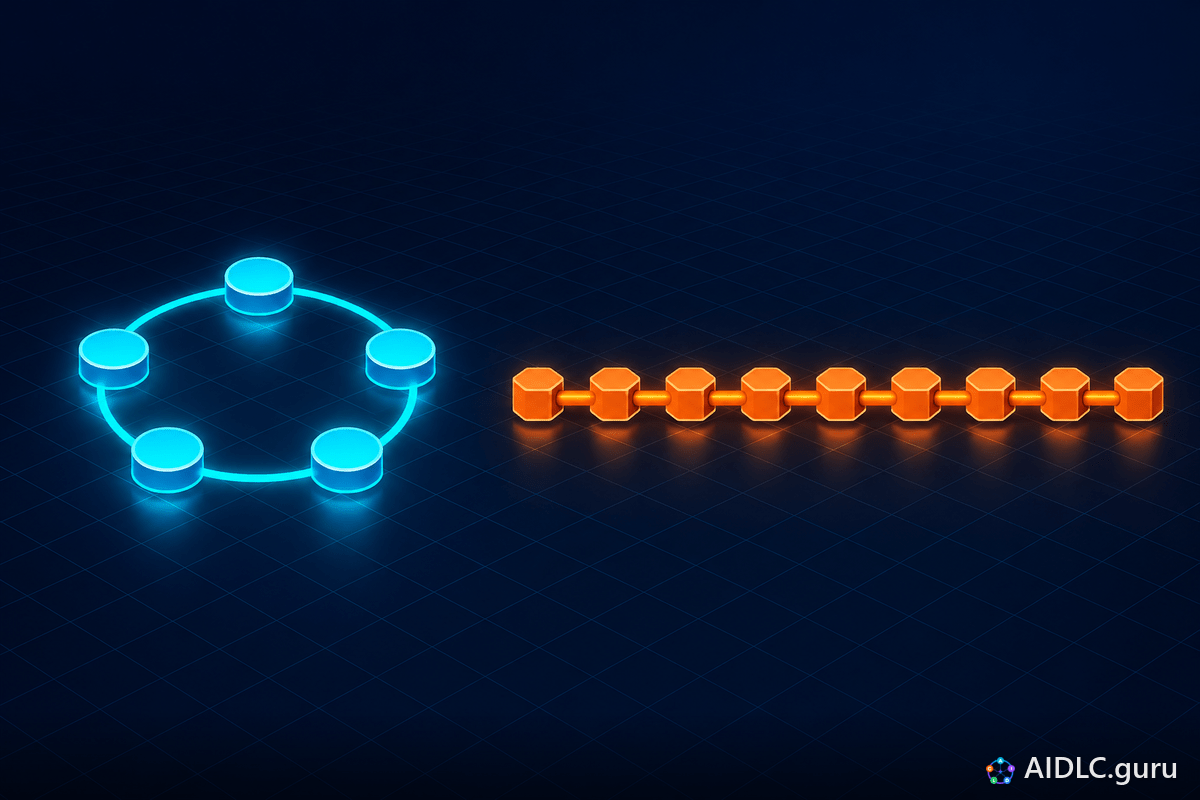
Same Acronym, Different Frameworks
AWS coined "AI-DLC" - the AI-Driven Development Life Cycle - in 2025 as its methodology for agentic software delivery, first described as three phases. What it ships today is broader: AI-DLC Workflows reached version 2.11.3 in November 2026, and its documentation now describes five phases across 33 stages, installed as a native command that runs inside seven coding agents.
The AIDLC framework documented on this site is a five-phase lifecycle developed independently around the same conviction: that the SDLC must be rebuilt around AI. Two frameworks arriving at nearly the same name is not a coincidence - it is a sign of where the whole industry is heading.
A third meaning sits under the same words: many people searching for "AI development life cycle" mean the lifecycle of building a machine learning model - data, training, evaluation, deployment and MLOps. That is a different discipline again, compared on AIDLC vs the ML Lifecycle.
Side by Side
Both frameworks are real, current, and useful. Here is how they differ.
AIDLC (this site)
- Phases: Five - Analyze, Ideate, Develop, Launch, Curate
- Center of gravity: Methodology and mental model
- Tooling stance: Tool-agnostic - works with any assistant or agent
- Scope: The whole delivery loop, from requirements to production curation
- Origin: Independent framework documented on this site
AWS AI-DLC
- Phases: Five - Initialization, Ideation, Inception, Construction, Operation - broken into 33 stages
- Center of gravity: Workflow tooling installed into coding agents
- Tooling stance: One harness-neutral core that runs in Claude Code, Kiro CLI, Kiro IDE, Codex CLI, Cursor, opencode, and GitHub Copilot
- Scope: The whole lifecycle in 33 stages, with per-intent state, approval gates, and an audit trail
- Origin: Created by AWS, which cites 100+ customer experiments behind it
AI-DLC by the Numbers
What AWS documents for AI-DLC Workflows as of version 2.11.3, released in November 2026. Every figure comes from AWS's own repository, release notes and user guide.
Stages across five phases: Initialization, Ideation, Inception, Construction and Operation.
Agents in AWS's user guide: 11 domain experts, two reviewers and a composer.
Workflow profiles, from a short bug fix to a full enterprise run.
Coding-agent harnesses it installs into, from Claude Code to GitHub Copilot.
Audit event types counted in AWS's 2.11.3 guide.
Customer experiments AWS cites behind the methodology.
Phases: first described by AWS in 2025 as three, documented today as five.
Phases in AIDLC, for comparison: Analyze, Ideate, Develop, Launch and Curate, with no fixed stage count.
Source: awslabs/aidlc-workflows, its changelog and user guide. These numbers change between releases; the site's scheduled currency sweep re-checks them.
Phase Mapping
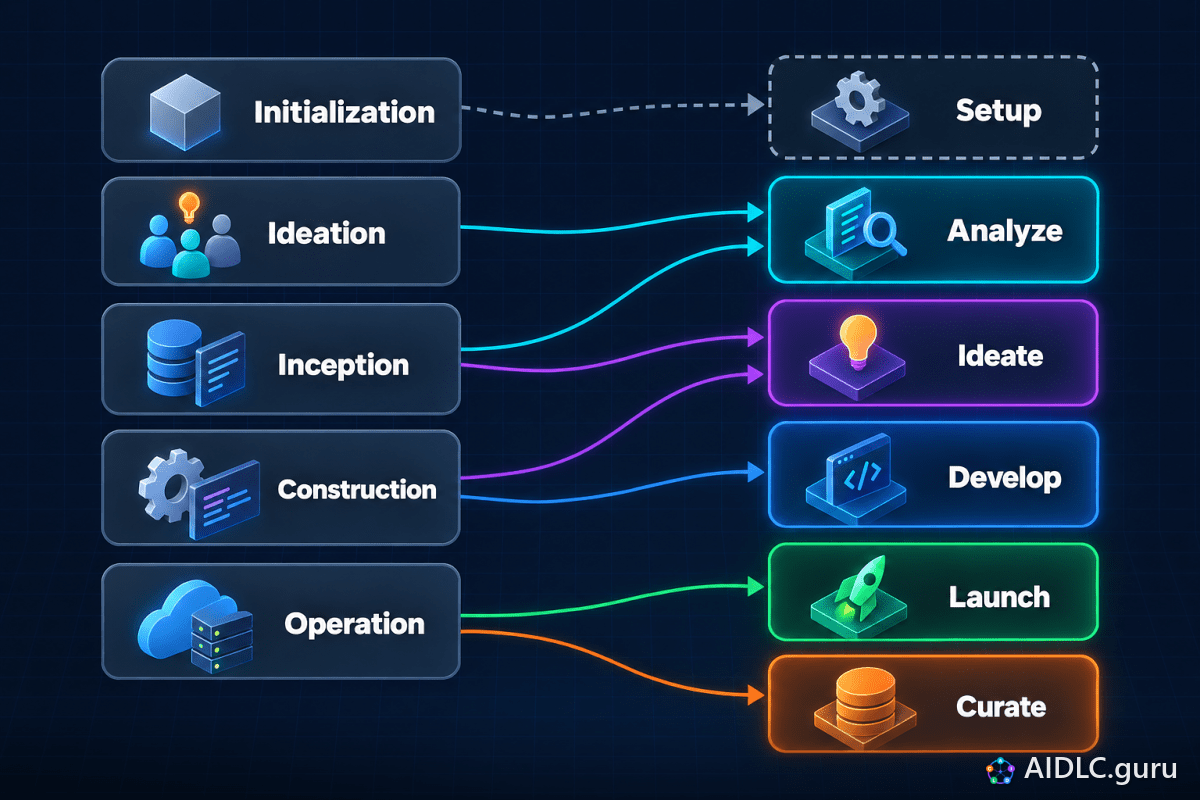
The nearest AIDLC phase for each AI-DLC phase, mapped by name and by the scope AWS states. Stage-level boundaries differ, so check AWS's user guide before relying on a one-to-one match.
| AWS AI-DLC phase | Nearest AIDLC phase | How they line up |
|---|---|---|
| Initialization | Setup before the cycle | Configures the project and harness. AIDLC treats the equivalent as setup rather than a phase: the usage policy, the repo instruction file and a baseline, covered in the Rollout Playbook's Phase 0. |
| Ideation | Analyze | Research and feasibility before requirements are fixed. |
| Inception | Analyze and Ideate | Turning intent into requirements and units of work; AIDLC splits this into the signed brief and the agent-executable spec. |
| Construction | Ideate and Develop | Design, code and tests. AIDLC puts the design decision and its ADR in Ideate, and the tests-first build in Develop. |
| Operation | Launch and Curate | Deployment, operation and feedback. AIDLC separates release assurance from the ongoing learn loop. |
One Core, Many Harnesses
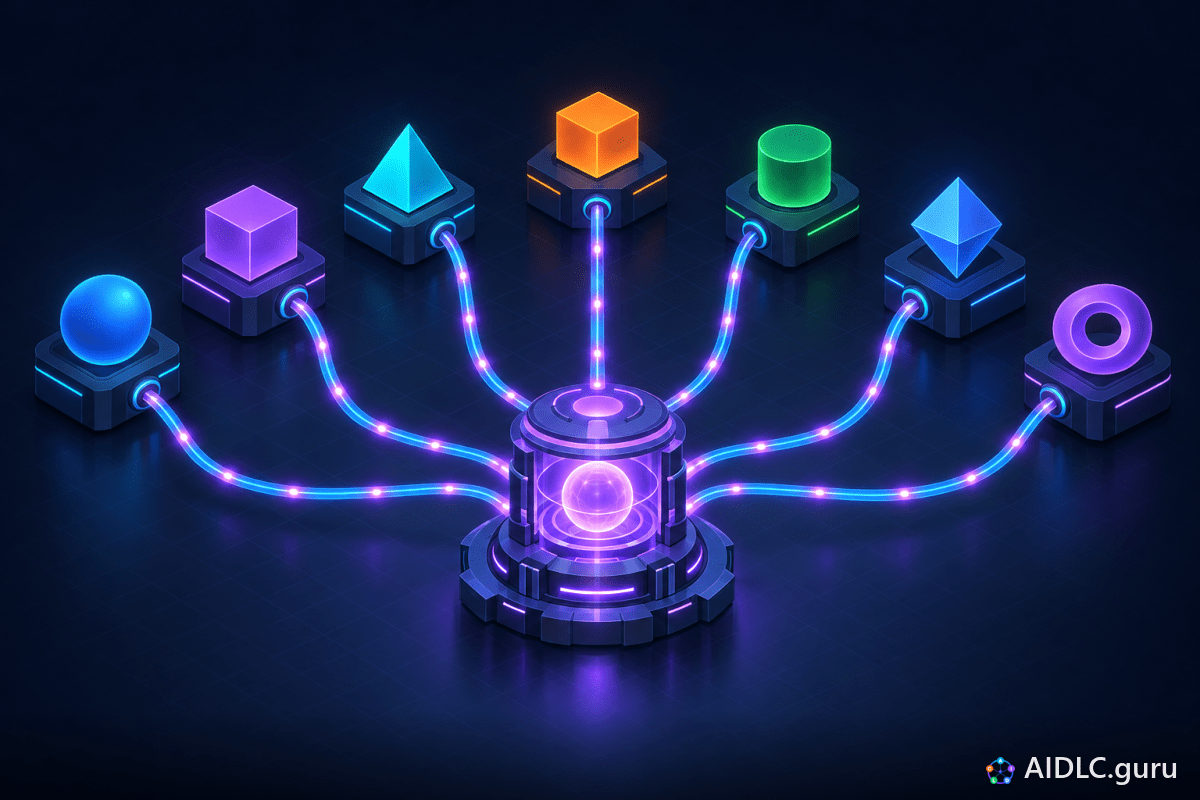
"One core, many harnesses" is how AWS now describes AI-DLC: a single harness-neutral engine that installs into whichever coding agent you already run. You install a native command, point a project at one harness, and start work by describing it. The methodology is identical everywhere; what differs is the shell around it.
What arrives with it is prescriptive. AWS documents five phases and 33 stages, a roster its user guide counts as 14 agents - 11 domain experts, two reviewers, and a composer - 11 workflow profiles that range from a short bug fix to a full enterprise run, human approval gates at stage boundaries, and an audit trail its 2.11.3 guide counts as 131 event types. That is a different kind of artifact from a lifecycle model - it is an engine with opinions about your next move, which is exactly its appeal and exactly its cost.
Two things are worth knowing before you plan around it. The harness is configured per project, and since version 2.10.0 more than one compatible harness can be configured side by side, with everything the workflows produce kept in one harness-neutral directory committed to the repository. And Amazon Q Developer is no longer on the list: AWS has announced end of support for its IDE plugins and paid subscriptions in April 2027 and points those customers at Kiro instead.
One Bug Fix, Both Ways
An invented example: a customer reports that invoice totals round incorrectly on half-cent amounts. The AI-DLC column describes the workflow at the level AWS documents it; consult AWS's guide for the exact stages a profile runs.
| Step | With AWS AI-DLC | With AIDLC | Using both |
|---|---|---|---|
| Start | Describe the bug to the native command and choose a short bug-fix workflow profile. | Open a ticket contract: the failing behavior as Given/When/Then, the risk tier (money math, so Tier 3), and a rollback plan. | The ticket contract comes first; the workflow starts from it. |
| Reproduce | The workflow's agents work through the stages the profile includes. | The agent writes a failing test that reproduces the half-cent case before touching the code; see bug to failing test. | Require the failing test as the first output, whichever engine produces it. |
| Approve | A person answers the approval gates at stage boundaries. | A person approves the plan, then two reviewers plus an architect approve the diff at Tier 3. | The ticket owner answers every gate; nothing is auto-approved. |
| Evidence | The audit trail records the workflow's events; outputs land in a harness-neutral directory in the repository. | The pull request names the agent, the ticket and what a human verified; the mutation gate runs on the money module. | Link the workflow's output directory and audit trail from the pull request. |
| Afterward | The fix ships through your existing release process. | The fix ships behind a flag; the incident closes only with a rule and a test for rounding modes. | AIDLC's release plan and learn loop apply to every change, whoever generated it. |
When to Reach for Which
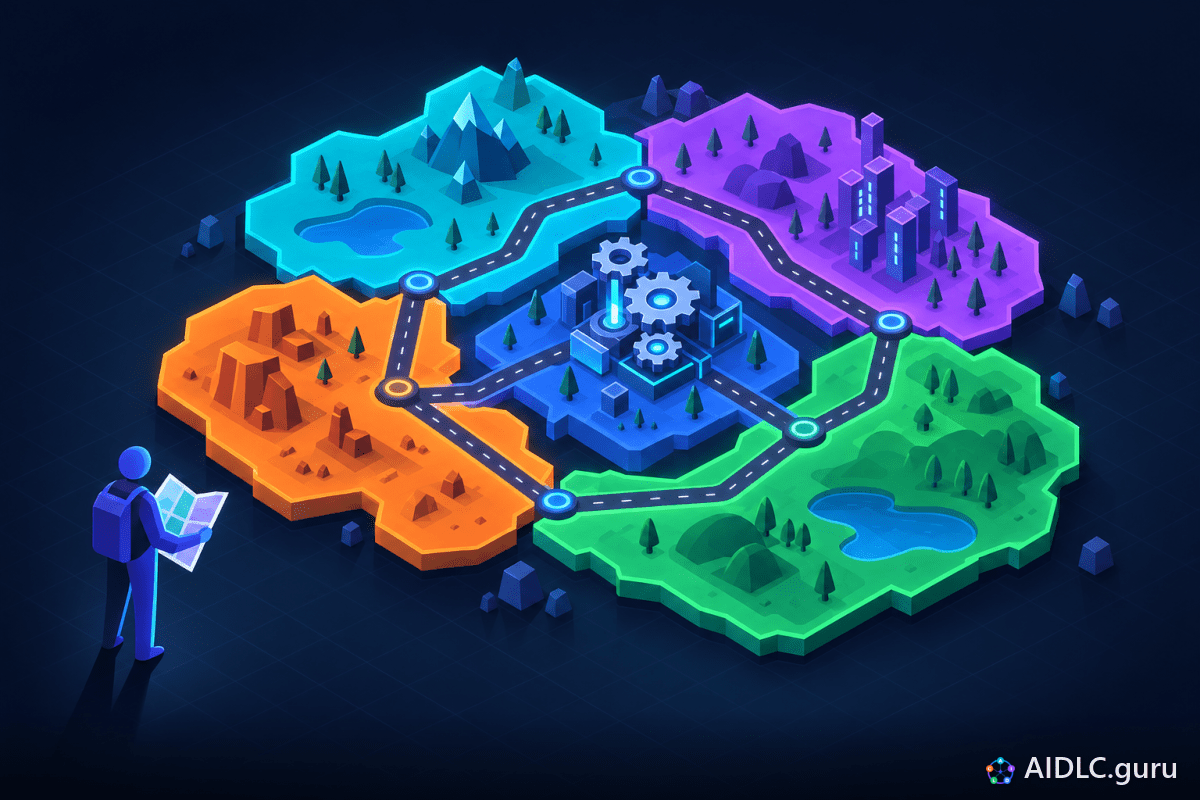
They are complementary rather than competing. AWS's AI-DLC installs concrete, opinionated workflows into your coding agent - a real, working answer to "how should an agent run a delivery task?" AIDLC gives you the lifecycle mental model that organizes everything around the build loop, including the phases before a prompt is written and after the deploy lands.
The overlap is wider than it used to be. AWS's stages now reach back into research and feasibility and forward into deployment and feedback, so this is no longer a clean division of labor. A team can still adopt AWS's workflows where they bite hardest - Develop and Launch - while using AIDLC's five phases to structure the whole, from the analysis that decides what to build to the curation that feeds production learning back into the next cycle.
Whichever shape you adopt, the underlying skill is the same: describing work clearly enough that an agent can execute it, and reviewing what comes back with judgment. That discipline is context engineering, and it pays off in either framework.
Decision Checklist and Template
A checklist for choosing, and an instruction-file section for teams that run AWS's workflows inside AIDLC's phases. Both are starting drafts to adapt.
Which to adopt
Lean toward AWS AI-DLC workflows if most are true
[ ] You want an opinionated, ready-made workflow inside the agent
[ ] Your teams already run one of its supported harnesses
[ ] You want a built-in audit trail and stage-by-stage approval gates
[ ] You would rather adopt a maintained engine than write your own process

Lean toward AIDLC as the frame if most are true
[ ] You need one lifecycle across many tools, teams and vendors
[ ] Your gaps are governance, review capacity, measurement or rollout
[ ] You need owners for the work before the prompt and after the deploy
[ ] The method has to survive a change of agent or vendor

Use both if
[ ] You want AWS's workflows inside Develop and Launch, with AIDLC's
    ticket contracts, risk tiers, release plan and learn loop around them
Instruction-file section: AI-DLC inside AIDLC
## Running AI-DLC workflows inside our AIDLC phases

- Analyze and Ideate stay human-approved: the requirements brief and the
  ADR are signed before any workflow starts.
- Every workflow starts from an approved ticket contract. Pick the smallest
  workflow profile that fits the ticket's risk tier.
- The first output is a failing test for each acceptance criterion.
- Every approval gate is answered by the ticket owner. Never auto-approve.
- Commit the workflow's output directory and link it, with the audit
  trail, from the pull request.
- Review follows our risk tiers, whatever the workflow's own reviewers said.
- Release plans, rollback paths and the learn loop apply to every change,
  whichever engine produced it.
Frequently Asked Questions
No. They share an acronym but not a shape. AWS's AI-DLC is a delivery methodology whose shipped workflows document five phases across 33 stages - Initialization, Ideation, Inception, Construction, and Operation - installed as an engine inside your coding agent. The AIDLC framework on this site is a five-phase lifecycle - Analyze, Ideate, Develop, Launch, and Curate - focused on methodology over tooling.
No. AIDLC.guru is an independent reference site written and maintained by RJ Lindelof. AWS's AI-DLC methodology and its workflow tooling are AWS's own work, and this site covers them as a related but separate approach.
Yes. They are complementary rather than competing. AWS's AI-DLC installs concrete workflows into your coding agent, while AIDLC gives you the lifecycle mental model for the whole delivery loop. Use AWS's tooling where it fits and AIDLC's five phases to organize the work around it.
One Acronym, Room for Both
Learn the five-phase framework, keep the cheatsheet handy, and borrow the best of both approaches.